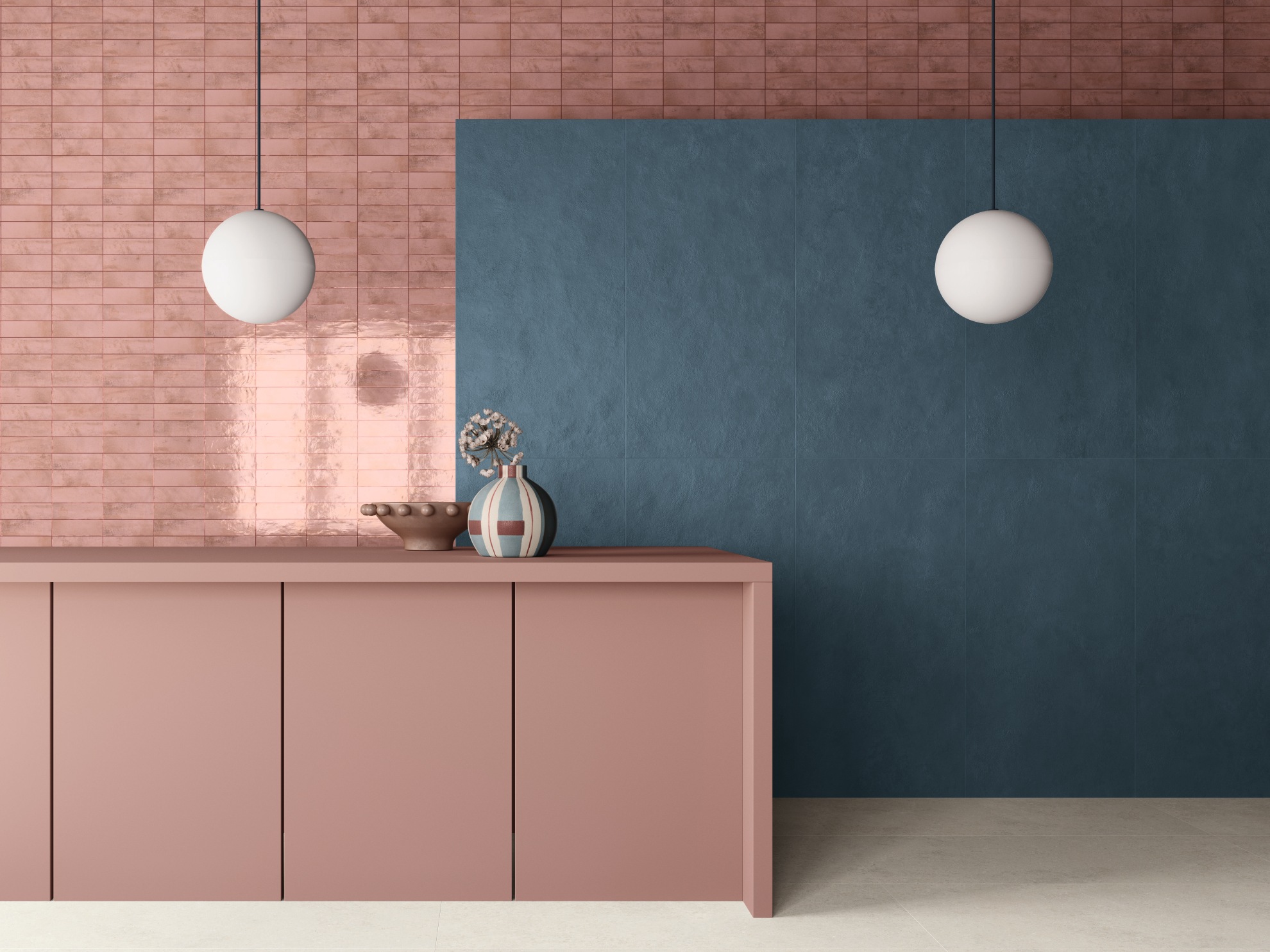
For years, interior design has found safe ground in neutral tones. Whites, beiges, greys, natural stone and wood have shaped a language associated with serenity, sophistication and timelessness. Yet their widespread use has also contributed to a certain uniformity in interiors, making it increasingly difficult to recognise the personalities of those who inhabit them.
APE Grupo arrives at Cersaie 2026 with a proposal to restore confidence in colour. Under the Rainwow concept, the company champions colour’s ability to bring identity, emotion and optimism to spaces, without sacrificing the calm and natural feel that contemporary living demands.
The aim is neither to replace neutrals nor to turn colour into an exercise in excess. The proposal is rooted in their coexistence: mineral, stone-inspired and earthy foundations provide a backdrop for colour accents capable of transforming the perception of an entire space. Colour is used with intention, wherever it can create contrast, depth, rhythm or a point of visual tension.
This approach means understanding colour beyond its decorative dimension. Colour becomes a design tool: it can articulate surfaces, highlight volumes, establish relationships between materials and create different atmospheres. Applied with precision, a touch of colour can change how a space is perceived without having to dominate it.
Rainwow thus reflects a more emotional and personal approach to interiors. Rather than spaces designed to be universally appealing, APE Grupo champions interiors that express an identity of their own. Sophistication no longer depends on the absence of colour, but on the confidence with which it is used.
The confidence in colour embodied by Rainwow runs through the new ceramic designs that APE Grupo is presenting in Bologna, taking different forms. Creative concepts such as Axis and Lithos, alongside Carmen’s new collections, explore different relationships between colour and material, from introducing unexpected nuances into nature-inspired surfaces to creating contrasts with highly expressive materials or developing extensive colour palettes.
Axis explores colour as an element capable of organising, connecting and transforming a collection. Its starting point is ceramic surfaces inspired by stones with a serene character, developed in white and ivory. Against this neutral foundation, the Sicily collection introduces a more colourful interpretation of stone through four shades—brown, green, ivory and pink—preserving its mineral richness while incorporating less predictable nuances. This contrast does not break with the overall natural language; instead, it expands the possibilities, allowing a transition from seamless, serene compositions to others with a stronger personality.
Lithos proposes a different relationship between balance and expression. This concept combines ceramic surfaces inspired by neutral stones with others that reinterpret exotic marbles featuring intense colours, pronounced veining and striking patterns. The contrast between these two worlds makes it possible to adjust the visual prominence of the surfaces: stone provides a restrained foundation, while marble introduces energy, depth and a more theatrical dimension.
Colour takes on another dimension at Carmen, APE Grupo’s brand specialising in decorative and small-format tiles. Its new collections feature particularly extensive palettes, allowing designers to work with different degrees of intensity within a single collection. Neutrals and pastels sit alongside earthy shades, terracottas, burgundies and blues, with greens playing a prominent role, from soft nuances to deep tones. Collections available in up to fifteen colours make small-format tiles a versatile tool for creating tonal harmonies, combining colour families or introducing more pronounced contrasts.
This pursuit of greater expressive potential finds one of its clearest manifestations in Canvas. APE Grupo’s proposal starts from a simple idea: to see ceramics as a creative canvas and expand the possibilities of the surface beyond traditional visual languages.
At Cersaie, Canvas is presented through a collaboration with Studiopepe, continuing the partnership launched during Milan’s Fuorisalone with Lagomar. Terranera and Montaña Roja now join the proposal, completing a series of three murals in which ceramics become a visual narrative articulated through signs, archetypal geometries and textured surfaces.
Inspired by the landscapes of southern Spain and its islands, the series unfolds as a layering of signs: from fragments and incisions associated with travel to forms that seem to emerge from volcanic earth, culminating in an almost metaphysical landscape where nature and architecture find a balance between land and water.
Colour, material and gesture connect the three designs through warm earthy tones, from sand and terracotta to the deepest browns, illuminated by accents that introduce rhythm and depth. These are three distinct languages sharing the same sensibility and an ongoing dialogue between nature and architecture.
The collaboration with Studiopepe gives tangible form to the ambition behind Canvas: to turn the ceramic surface into an open field for experimentation and new forms of expression, in dialogue with architecture and design professionals.
Cersaie also marks a new step in the evolution of Ilbagno, APE Grupo’s bathroom brand and a key part of the company’s expansion into new solutions for living spaces.
Relaunched a few months ago, Ilbagno has enabled APE Grupo to extend its expertise in materials and design beyond ceramic surfaces and introduce new product categories, including furniture, washbasins, taps and mirrors. The aim is to approach the bathroom as a complete space, where materials, fittings and functional elements can work together within a single design.
This new phase took shape with Contemporary, a concept launched with three product lines—Horizon, Lines and Arch—conceived with different design languages but sharing a common vision. Horizon emphasises horizontality and the interplay of volumes; Lines is built around vertical rhythm and geometry; and Arch makes the curve its most recognisable feature. All three share a coordinated approach to the bathroom and extensive scope for personalisation through materials, finishes and colour.
At Cersaie, Ilbagno expands its catalogue with Anne, which embraces a refined, architectural aesthetic in which precise lines combine with soft transitions to create a balanced and sophisticated look. The distinctive character of its taps and the vertical relief of the furniture bring rhythm and depth to the ensemble, shaping a contemporary, elegant space with a strong design identity.
Ultimately, Ilbagno’s evolution represents a broader move for APE Grupo: from primarily offering ceramic surfaces to developing solutions that enable a more integrated approach to living spaces, with design, materiality and the ability to combine elements remaining common threads.
The Rainwow concept also extends to APE Grupo’s stand at Cersaie, conceived as an architectural landscape in which the collections are integrated into different settings and spatial arrangements.
On the exterior, a parametric façade made up of vertical slats in different colours introduces an interplay of colour whose perception changes as visitors move around it. Inside, curved geometries, arches, lighting, greenery and changes in texture articulate a succession of atmospheres in which surfaces, bathroom fittings and design elements are integrated into the space as part of the architecture itself.
Together, these elements encapsulate APE Grupo’s proposal for Cersaie 2026: to reclaim colour as a tool for designing spaces with identity, rather than as a passing trend. Surfaces, materials, fittings and colour come together to move towards more personal, expressive living spaces that can evoke emotion.




 Return